

What Are the 7 Churches of Revelation?
When the apostle John was exiled to the island of Patmos toward the close of his life, he had an extraordinary vision and was told, “What you see, write in a book and send it to the seven churches” (Revelation 1:11).
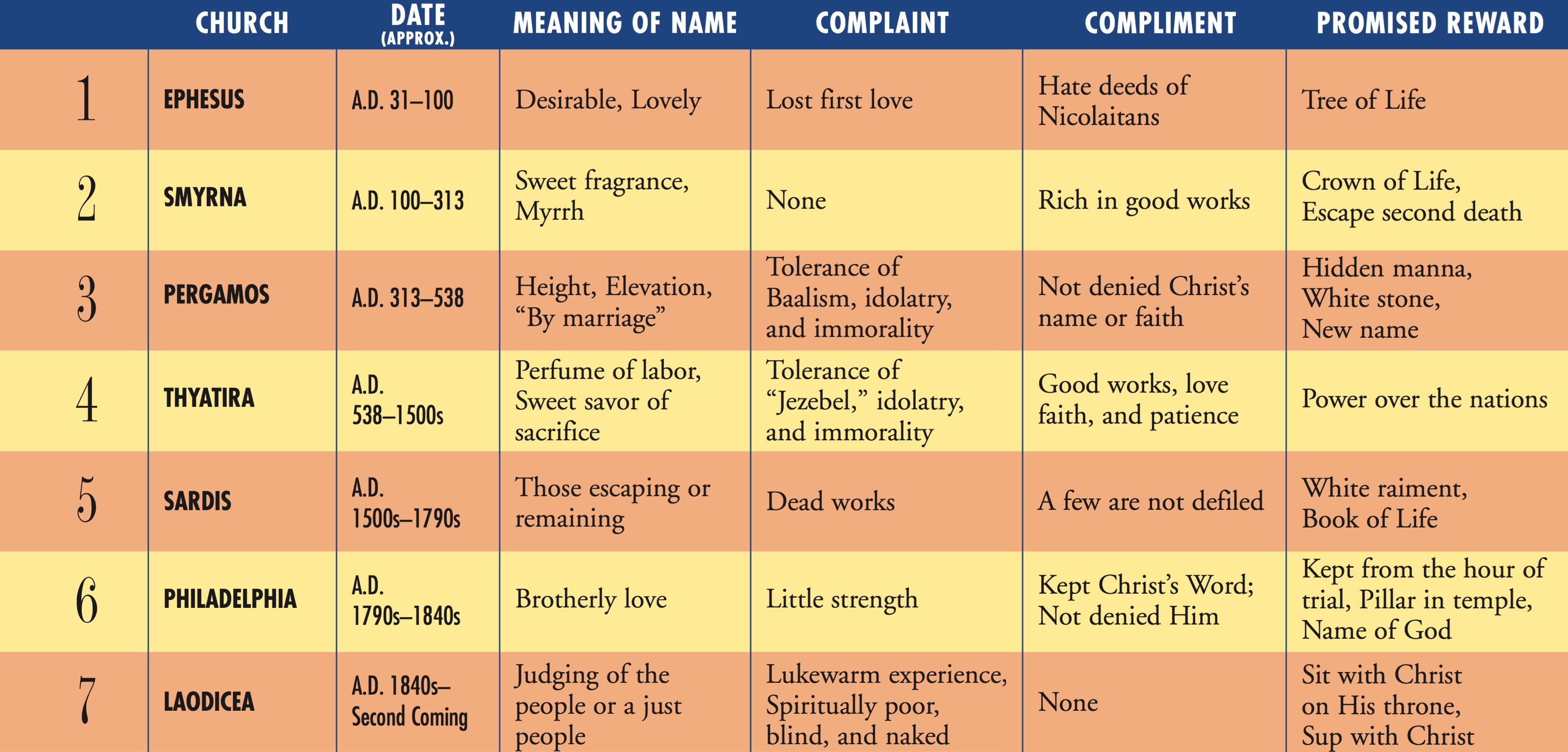
Seven Churches List:
Overview of the Seven Churches
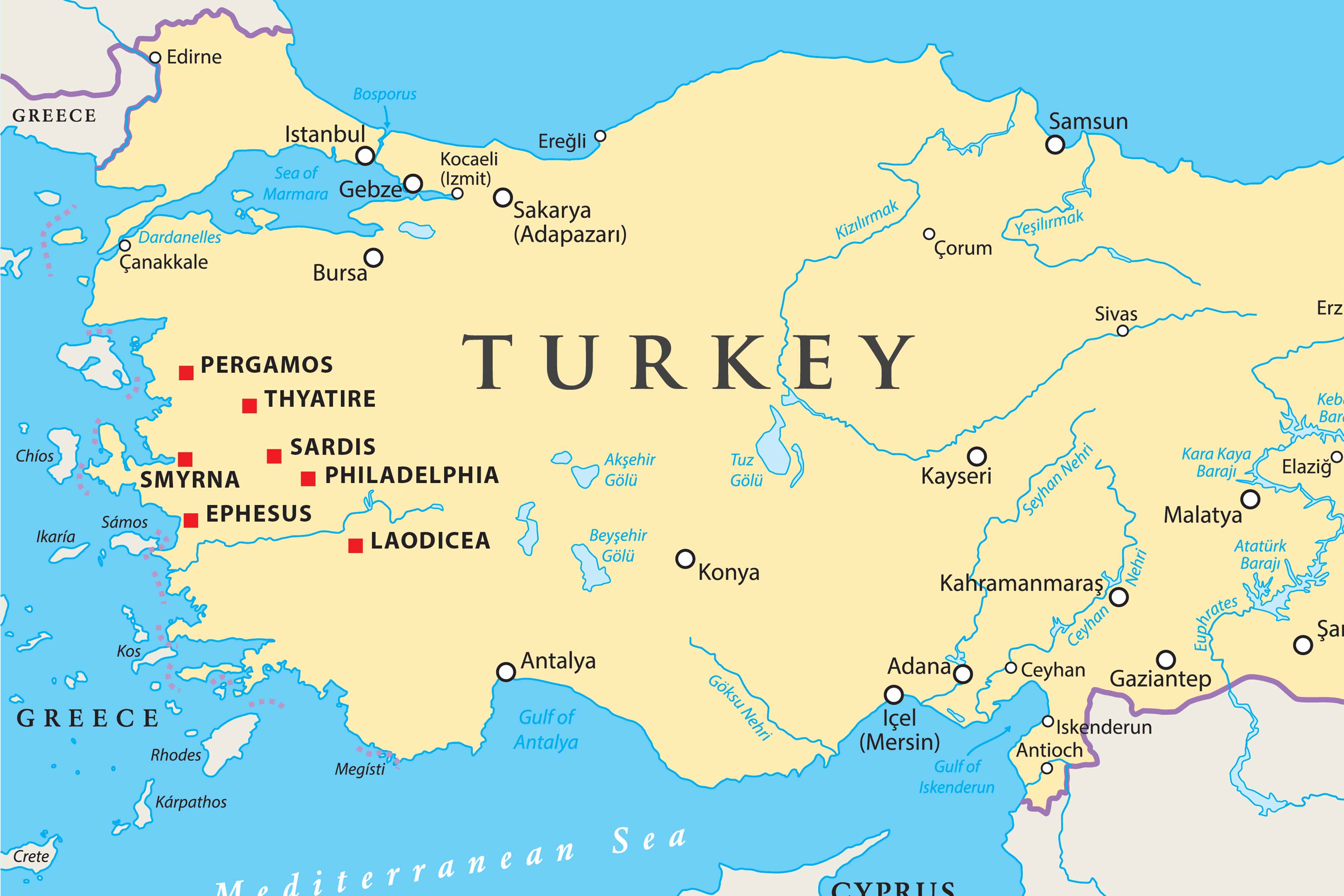
The angel calls each of the seven churches by name: Ephesus, Smyrna, Pergamos, Thyatira, Sardis, Philadelphia, and Laodicea. These were all names of real cities in the Roman province of Asia, also called Asia Minor or present day Turkey. This was the field of labor of the apostle Paul and others who followed immediately after the apostles.
These seven churches received real messages with warnings addressed to them and real blessings pronounced upon them. But these messages, warnings, and blessings also apply to seven periods of church history reaching from the first advent of Jesus to His second coming and including our present era. The messages are also prophetic for each time period, describing the condition of the Christian church throughout time leading up to the conclusion of the world.
In these messages the good qualities of each church is pointed out as well as its defects. Admonitions and warnings are given to each, and, finally, an especially appropriate blessing is pronounced.
Ephesus
The message to the first church begins, “To the angel of the church of Ephesus write.”
Ephesus symbolizes the condition of the church in its first state of purity in the days of the apostles of Christ. Christ’s followers received His doctrine, kept it and enjoyed the benefits and blessings of the gifts of the Holy Spirit.
But Jesus declares that he has something against even this first period of the Christian church, because he says in Revelation 2:4 “you have left your first love.”
The first followers of Christ, who were on fire with their love for Him and for His gospel, eventually saw a cooling in their willingness to serve Him. Maybe they lost their first fervent love because they no longer saw Him physically in their midst or maybe because speaking of the good news became common place. For whatever reason, Jesus says that they no longer felt or expressed the first pure Christian love that they had previously.
“Remember therefore from where you have fallen; repent and do the first works” (Revelation 2:5).
If we allow God to restore His infinite love in our lives, we will find our first love returning with new life. Then we will be empowered to renew the first works of salvation: obedience, earnest Christian service, willingness to suffer for the Master, love of the truth and a desire to make known to others the gospel of Christ.
Smyrna
This period of Christian history covers the time of pagan Roman's persecution of Christinas when many of God's children suffered martyrdom in the second, third, and early fourth centuries. To these suffering, persecuted Christians the message came:
“Do not fear any of those things which you are about to suffer. Indeed, the devil is about to throw some of you into prison, that you may be tested, and you will have tribulation ten days. Be faithful until death, and I will give you the crown of life” (Revelation 2:10)
The most severe persecutions by pagan Rome began under Emperor Diocletian and continued from the year 303 to 313, exactly ten years, or ten prophetic days. (In Scripture a prophetic day often stands for a year.) It was in these days that being a Christian could cost a person's earthly life, but Jesus has promised those who suffer for His name a crown of life that will never fade.
Pergamos
The word pergamos means height or elevation, and the city of Pergamos itself was built on a lofty hill. It represents the period of Christian history following the conversion of Emperor Constantine to Christianity and the setting up of the full union of church and state.
The church which formerly was persecuted and, like her Savior, had no place to lay her head, gradually grew into a mighty power which could command untold wealth and the armies of imperial Rome.
As a result of this unsuitable union, many heathen rites and ceremonies were gradually introduced into the church. In this way the pure faith of the early church was corrupted. But there remained many faithful believers in those days of whom Jesus spoke:
“I know your works, and where you dwell, where Satan’s throne is. And you hold fast to My name, and did not deny My faith” (Revelation 2:13).
This is a wonderful testimony about the true servants of God. The Lord knows each person’s situation and faithfulness. He helps his children to stand firm in the face of hardship and temptation.
Thyatira
This church symbolizes the condition of God's people during the Dark Ages of persecution. During this time period, the organized church itself became the persecutor. Our Savior referred to this period in His wonderful prophecy recorded in Matthew 24. He said:
“For then there will be great tribulation, such as has not been since the beginning of the world until this time, no, nor ever shall be. And unless those days were shortened, no flesh would be saved; but for the elect’s sake those days will be shortened” (Matthew 24:21- 22).
God has a special promise for His persecuted children in Revelation 2:25-26, 28: “But hold fast what you have till I come. And he who overcomes, and keeps My works until the end, to him I will give power over the nations… I will also give that one the morning star.”
Jesus is the Morning Star. Here He is promising us Himself. Jesus wins in the end. He is promising us the victory even before it happens!
Sardis
The Sardis church represents the time period after the early reformer’s rediscovery that individuals cannot earn their salvation. As the reformers died and the novelty of this new idea of righteousness by faith wore off, increasing lethargy and spiritual complacency seeped into the church. Again, compromise with paganism became prevalent (Plain Revelation by Ranko Stefanović) to the point where Jesus says to this church, “I know your works, that you have a name that you are alive, but you are dead” (Revelation 3:1).
The most heartbreaking part of this rebuke from Christ is that the church thinks it is alive, but is, in reality, dead. Christ’s solution to this state of spiritual death is remembering the Source of salvation and repenting. “Remember therefore how you have received and heard; hold fast and repent” (Revelation 3:3). Only remembering the true Way to salvation (Jesus is the Way, John 14:16), asking for forgiveness, and turning way from past mistakes can revive lifeless religiosity.
But there is good news! Jesus has three promises for those who choose to repent. He will give them the white robes of His righteousness to wear, include their names in the Book of Life and bring their names up in commendation before His Father and the angels (Revelation 3:5).
Philadelphia
Philadelphia means “brotherly love”, and applies to the church during the Great Advent Awakening and the days that succeeded it. The church of Philadelphia receives no words of condemnation. Instead, Jesus recognizes that this church has but little power and it receives many promises of hope and guidance. “… I have set before you a door, which no one is able to shut… I will keep you from the hour of trial… I will make [him] a pillar in the temple of my God…I will write on him my new name” (Rev. 3:8, 10, 12).
Revelation 3:11 is a final reminder that we will not have to wait long for our reward. “Behold, I am coming quickly! Hold fast what you have, that no one may take your crown.”
Laodicea
Laodicea means “the judging of the people”. Notice Christ's words: “I know your works, that you are neither cold nor hot. I could wish you were cold or hot” (Revelation 3:15).
This church represents the current period of Christianity. Lukewarm Christianity is one of the dangers of our time. Modern Christians who claim Christ’s name but that are not fully invested in knowing and serving Christ are the ones that this church is warning against.
Notice Jesus’ next words: “Because you say, ‘I am rich, have become wealthy, and have need of nothing—and do not know that you are wretched, miserable, poor, blind, and naked—I counsel you to buy from Me gold refined in the fire, that you may be rich; and white garments, that you may be clothed, that the shame of your nakedness may not be revealed; and anoint your eyes with eye salve, that you may see. As many as I love, I rebuke and chasten. Therefore be zealous and repent” (Revelation 3:17-19).
We may have beautiful church buildings, we may have large budgets; but we need the divine riches of faith, hope and love. We need the white raiment of Christ's own righteousness, which is ours for the asking and receiving.
This is the final promise before our Savior's return. His promise for us when He comes is that we will sit with Him on His throne with new white robes and with eye salve so that we can see and we will enjoy the riches of His presence for eternity.
Conclusion
The messages of these 7 churches serve as a warning for us today. Each church has a problem that it must face. Each church has a challenge that it must overcome. But each church is given incredible promises, promises that help the church to overcome its challenges. Ultimately, the message to each church and to each person is a call from Jesus to let Him be the Lord of their lives.
“Behold, I stand at the door and knock. If anyone hears My voice and opens the door, I will come in to him and dine with him, and he with Me” (Revelation 3:20).
These words of Christ are for you. Won't you open the door now and let Him in to your heart?